
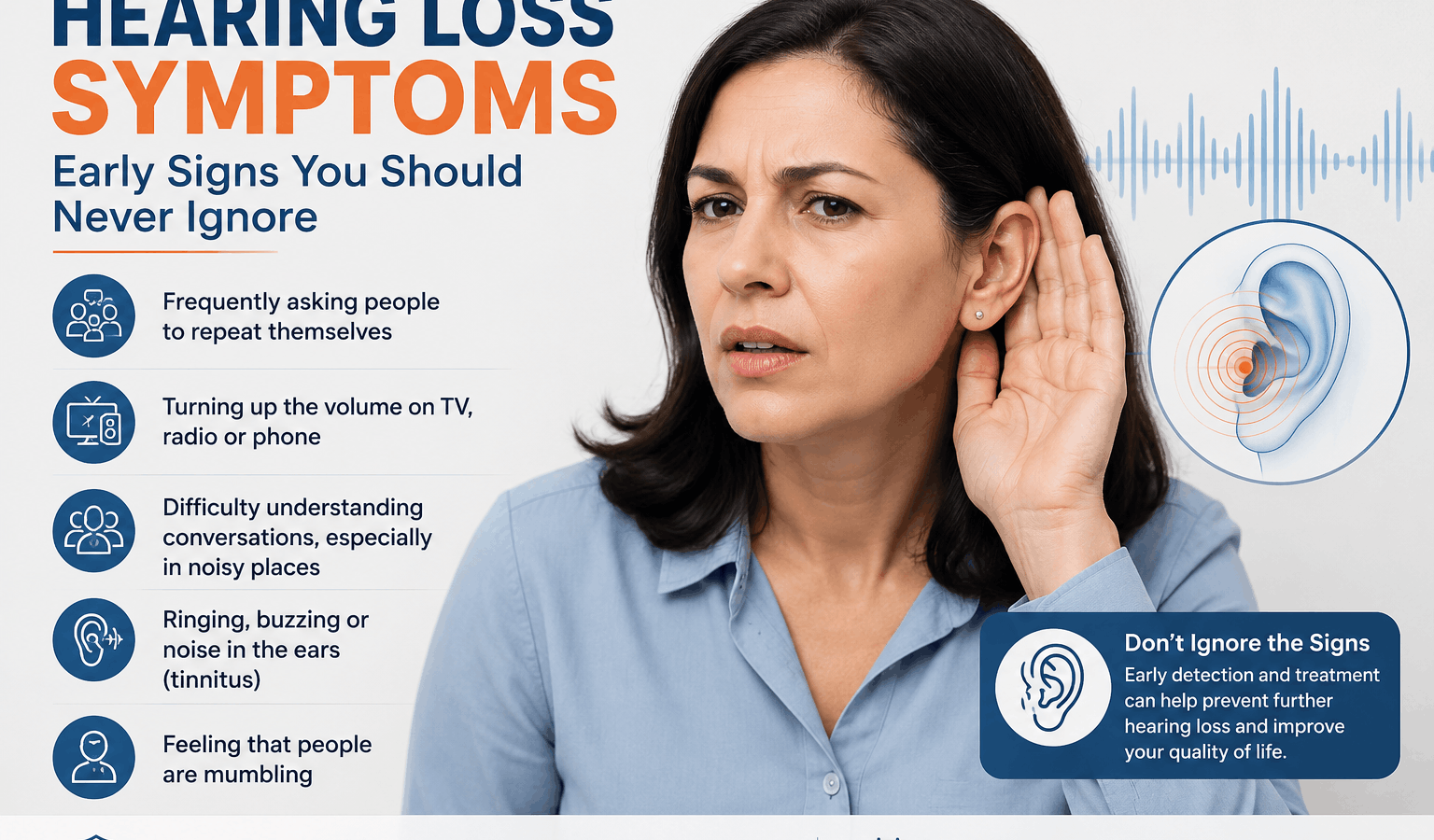
Hearing Loss Symptoms:
Early Signs You Should
Never Ignore
Most people lose 30–40% of their hearing before they notice anything is wrong. Knowing the early warning signs can mean the difference between a simple hearing aid and permanent, untreatable loss.
8 Symptoms of Hearing Loss
That People Dismiss Too Long
Hearing loss rarely arrives all at once. It creeps in quietly — and most people adapt without realising they are missing more and more. These are the signs to watch for.
Asking People to Repeat Themselves
Frequently saying “sorry, can you say that again?” — especially in normal, quiet conversation — is one of the clearest early signals. Many people blame the other person for mumbling rather than recognising their own hearing change.
Turning the TV Volume Up Higher
Needing a louder volume than others in the room find comfortable, or relying on subtitles when you never used to, is a classic early indicator. The high-frequency sounds in speech — consonants like S, F, TH — are usually the first to go.
Difficulty Hearing in Noisy Places
Restaurants, gatherings, and busy offices become exhausting. Following a conversation when there is background noise — while others manage easily — is a hallmark sign of sensorineural hearing loss affecting speech clarity.
Ringing or Buzzing in the Ears (Tinnitus)
A persistent ringing, buzzing, hissing, or whooshing sound — heard even in silence — is called tinnitus and affects around 1 in 10 adults. It is often an early sign of underlying hearing damage and should not be ignored.
Struggling on Phone Calls
Phone calls remove the visual cues — lip reading, facial expressions — that people with mild hearing loss unconsciously rely on. If calls are noticeably harder than face-to-face conversation, a hearing issue is often the cause.
Listening Fatigue & Withdrawal
Straining to hear all day is mentally exhausting. People often begin avoiding social situations, meetings, or gatherings — not from shyness, but because the effort of keeping up is draining. This can be mistaken for anxiety or depression.
Sudden Loss of Hearing in One Ear
Sudden sensorineural hearing loss (SSHL) — hearing that drops noticeably within 72 hours — is a medical emergency. Treatment within the first 48–72 hours with steroids can significantly improve recovery. Do not wait and see.
Trouble Locating Where Sounds Come From
The brain uses tiny timing differences between ears to locate sounds. If one ear hears differently to the other, this ability breaks down — making it hard to tell whether a voice is in front, behind, or to one side.
Signs of Hearing Loss
at Every Stage of Life
The symptoms of hearing loss look different depending on age. Recognising the pattern for the right age group leads to faster diagnosis and better outcomes.
- Does not startle at sudden loud sounds
- Does not turn toward a voice or sound by 3–4 months
- Not babbling by 12 months
- No single words by 15–18 months
- Only responds when looking directly at you
- Seems to hear some sounds but not others
- Delayed or unclear speech compared to peers
- Frequently asks “what?” or “huh?”
- Inattentive in class — often misdiagnosed as ADHD
- Turns the TV volume very high
- Does not respond to their name called from another room
- Struggles at school, especially with reading
- Difficulty following group conversations
- Missing consonants in words (S, F, TH, SH)
- Ringing or buzzing (tinnitus) in quiet rooms
- Fatigue after social events or meetings
- Avoiding phone calls or large gatherings
- Family members complaining about TV volume
⚠ Sudden Hearing Loss Is a Medical Emergency
If your hearing drops noticeably within hours or a few days — especially in one ear — please seek medical attention immediately. Treatment within 48–72 hours offers the best chance of recovery. Do not wait to “see if it improves.”
Who Is Most Likely to
Develop Hearing Loss
Certain factors make hearing loss significantly more likely. If any of these apply to you, a routine hearing check is especially worthwhile — even if you have no symptoms yet.
Age Over 60
Age-related hearing loss (presbycusis) is the most common form. Over 50% of adults over 75 have clinically significant hearing loss — and it progresses gradually, making it easy to miss.
Noise Exposure at Work
Factory workers, construction workers, musicians, and military personnel face significantly elevated risk. Noise-induced hearing loss is permanent and entirely preventable with proper protection.
Loud Headphone Use
Listening above 85 dB for extended periods causes cumulative cochlear damage. Hearing loss from headphone use is increasing in younger populations globally — and is largely avoidable.
Ototoxic Medications
Certain antibiotics, chemotherapy drugs, and high-dose aspirin are toxic to the inner ear. If you are on long-term medication, ask your doctor about monitoring your hearing.
Family History
Genetic factors can predispose you to earlier or more severe hearing loss. If a close family member developed hearing loss in their 40s or 50s, you may be at higher risk.
Chronic Ear Infections
Recurrent middle ear infections, especially in children, can cause conductive hearing loss. Fluid behind the eardrum (glue ear) is particularly common in children under 5 and often goes undetected.
Questions About Hearing
Loss Symptoms
Honest answers to the questions we hear most often in the clinic.
Think You Might Have Hearing Loss?
A hearing test takes less than 30 minutes. The sooner it is done, the more options you have. Book an assessment at Kathmandu Hearing and Speech Clinic.
Book a Hearing Test